
Identity is the new challenge for investment trust boards
Piers Currie, Warhorse Partners
The conundrum facing boards relates principally to constituency; the defection of institutional investors, once reliable anchor tenants on share registers, has left a hole. Now even wealth managers are up to something. They are professionalising apace. One end is now selling “managed portfolios”, FCA classified “risk” buckets of open ended funds, for which closed end funds are structurally ill-suited. Meanwhile head offices order approved white lists of limited candidate funds. Many vehicles do not meet the rising bar. So abandoned by institutions and the wealth manager pool shrinking, boards eye their share registers with concern.
In days of yore, corporate governance was mandated by listing rules, regulatory announcements and corporate law. Corporate brokers would curate. As Boards increasingly cross the Rubicon into wider fields, known to managers as “promotion”, they steer, typically unregulated themselves, into the hugely-regulated space of conduct risk and consumer protection rules. These are the regulatory chapters rarely read by corporate lawyers. For this is the world of compliance. Here the brave new world of blame is firmly anchored on the manager in terms of risk, FCA, MiFID, AIFM, KYC, TCF and ancillary regulations, foreign and domestic.
Many investment trust managers have abandoned their savings schemes of old to avoid the density of service, regulation and administration complexity. Yet such unloved dinosaurs still however own twice the issued share capital of the sector as Hargreaves Lansdown. At this stage, unless reinventing the company as an alternative illiquid multi-asset fund with an income twist, many legacy equity vanilla vehicles, all sounding rather the same, will need to turn to better branding and identity to differentiate.
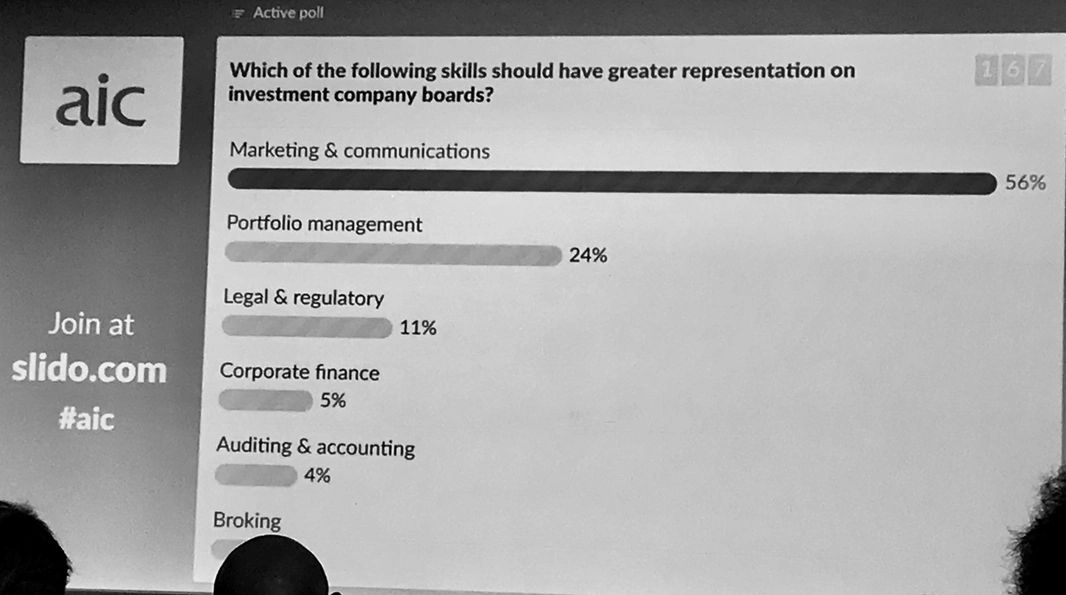
In March, the AIC membership in London gathered to address the issues facing the UK’s closed end fund governance. Perhaps unsurprisingly the talent gap they identified was the skill set in “marketing and communications”. Indeed it was the single largest vote winning talent gap, over twice that of polled “portfolio management” know-how and well over ten times that of corporate finance skills and audit skills. Before the managers get scolded, our straw poll of IT NEDs on LinkedIn revealed that only 40% were so installed. Keep galloping on; we are here to help.